
Yes, it's possible…
Fred Byrman demonstrated this last week (June 13) during the major Port Security Seminar 2019 organized by SERIS Security in collaboration with STC Training & Consultancy. During the three-hour seminar, attendees were presented with a well-structured and logically interconnected set of facts in just twenty minutes, with the common thread being the weak link in every security setup:the human element. Creating security awareness is of essential importance.
As an enthusiastic speaker with 15 years of experience in ISPS (EU Regulation 725/2004), he captivated the audience, moving from legislation, legal obligations, and requirements to management involvement (ISPS Article A/17.3) and screening based on risk assessments regarding human factors (ISPS Article A/15.5(4)) to the assessment of security measures against the objectives (ISPS Article A/16.3, specifically paragraphs 1 and 2) and finally to cybersecurity (ISPS, including B/15.16(5)).

Management involvement & support from the PFSO
From an ISO perspective, management commitment is nothing new. Quality and all other matters covered by various other standards are not issues that can simply be handed off to a QHSE manager or officer and then forgotten. Management must demonstrate its commitment (in a verifiable manner) and provide the necessary support to achieve the objectives. But did you know that something similar can be found in the ISPS Code? Mandatory Article A/17.3 states that the PFSO“shall be provided with the necessary support in the performance of the duties and responsibilities incumbent upon him under Chapter XI-2 and this Part of the Code [A].”
It is therefore understandable that when we draft a PFSP, it begins with a policy statement in which management pledges its support for the PFSO, promises to make the necessary resources available to achieve the objective, and defines that objective by citing the functional requirements from Article A/1.3.
Employee screening
One shortcoming of the ISPS Code is that it does not explicitly require that individuals who have access to sensitive information—such as the security risk assessment and the security plan—be screened. However, this does not mean that screening need not be part of the risk assessment. In fact, Article A/15.5, paragraph 4 of the ISPS Code states that the port facility security assessment must include, at a minimum (among other things):
“Identification of vulnerabilities, including human factors, in infrastructure, policies, and procedures.” Next, I would like to quote a passage from the port-wide directive (EU Directive 65/2005) which states that “To this end, the assessment must at least cover: ….. determining which members of port staff must undergo background checks and/or security screening because they have contact with high-risk areas.”
The term "areas" can be interpreted here to mean both physical and virtual areas. The PFSO is the person who has access to a great deal of highly sensitive security information, so it goes without saying that they must be screened. In addition, it is reassuring to know that, by employing security guards from licensed security organizations, this screening requirement is already met for security personnel and, in our case, security advisors as well.
The ISPS Code – mandatory, non-mandatory, and the verb “serve”
There is still some uncertainty regarding the obligations imposed by the ISPS Code on port facilities. The ISPS Code consists of two parts, with Part A designated as “mandatory” and Part B as containing “guidelines for the implementation of Part A.” The preface to the Code states that Articles B/16.3 and B/16.8 (minimum standards for a port facility’s security plan) should be read “as if they were mandatory.” However, many of the other articles in Section B/16 contain the word “shall.” An example of this is Article B/16.18, which states that:
Persons seeking access to the port facility must be subject to a search or inspection.
The word “serve” gives the impression of an obligation. What is the situation here? By using the verb “serve,” the legislature refers back to (mandatory) Article A/16.3, and in this case specifically to paragraph 1 of that article. This provision states that the port facility must take measures
If the contents of bags, suitcases, boxes, and vehicles are not inspected—even if only on a random basis as a deterrent—it cannot be said that measures have been taken as intended in the aforementioned article. Another example is Article B/16.13, which states, among other things, that all
Those who are unable or unwilling to prove their identity and/or confirm the purpose of their visit must be denied entry.
Here too, the legislature refers to Article A/16.3 through the use of the word “serve,” and in this case specifically to paragraph 2 of that article, which states that the port facility must take measures
To prevent unauthorized persons from gaining access to the port facility, to ships berthed at the port facility, and to restricted areas of the port facility.
Article A/1.3 (functional requirements) also states that this must be prevented
Unauthorized persons gaining access to ships, port facilities, and associated restricted areas.
If a person’s identity has not been verified, it cannot be stated with certainty that no unauthorized person has gained access.
Cybersecurity
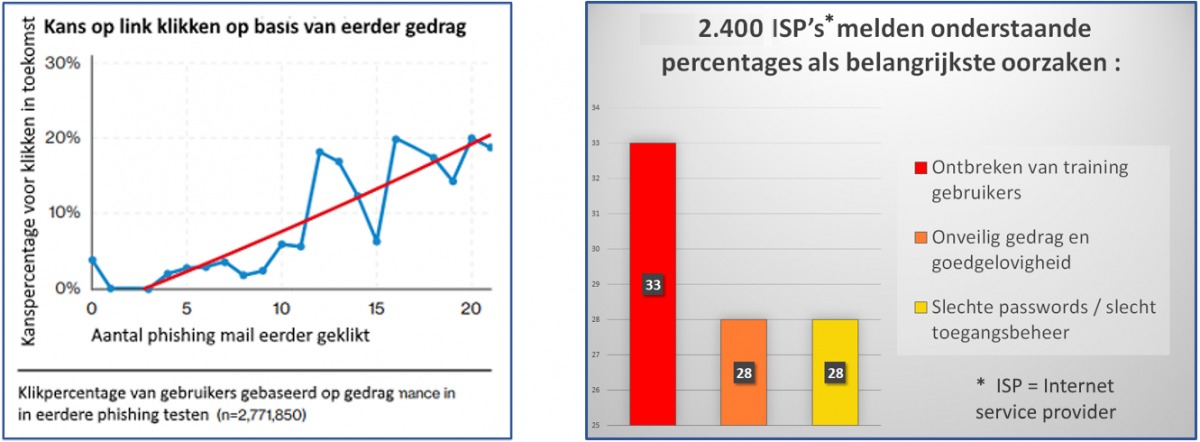
Cyber incidents are a constant threat that continues to be seriously underestimated. It is important to stay informed about threats and current developments, and the speaker regularly reviews the numerous reports published in this field. For the topic of cybersecurity, we have used data from sources including the most recent reports by Phishlab, Symantec, Verizon, and Datto. Did you know that people click on phishing emails in 4% of cases, and that as people have clicked more often without any consequences (for example, due to good network security that prevents dangerous links from opening), the likelihood that they will do so again rises to over 20%? These are alarming figures.
Phishing is a form of digital fraud. Phishing occurs via email, WhatsApp, and text messages (smishing), in which victims are lured, for example, to a fake website where they then disclose their banking or other login credentials, or where their computer is infected with malware (malicious software). Spear phishing involves a targeted attack on an organization or an individual. However, employees may also receive phone calls with stories designed to play on their emotions—such as gaining their trust or instilling fear—in order to extract information from them or get them to visit web pages, click on specific links, or install software.
People are the most vulnerable link in the entire chain, partly because they are too trusting, but certainly also due to a lack of knowledge. Because this lack of knowledge directly translates into risks for the employer (see chart at bottom right), it is essential to invest in employee training: fostering security awareness. And finally, there is the malicious insider—someone known within the company or even an employee—with malicious intent. Screening, as discussed earlier, is no guarantee against this, but a company can take a few simple steps to minimize the risk as much as possible. Don’t hesitate to apply the screening requirement more broadly than just the PFSO. Carefully consider who has access to sensitive information, as well as to locations and systems where damage can be caused. After all, inserting an infected USB drive into a system doesn’t require any special permissions on that system. Repeat the screening process discussed earlier at regular intervals. And ensure that, upon termination of employment, all necessary steps are taken to prevent access cards from remaining in circulation unintentionally and access codes and passwords from remaining active unnecessarily. Difficult? Cumbersome? Expensive?Try a successful (cyber)attack! All the more reason, then, to have employee screening and security awareness in order!
Fred Byrman is a Senior Security Consultant, Port Security Trainer, and Guest Instructor at STC Training & Consultancy, as well as an ISPS and ISO 9001:2015 Auditor and Lecturer.