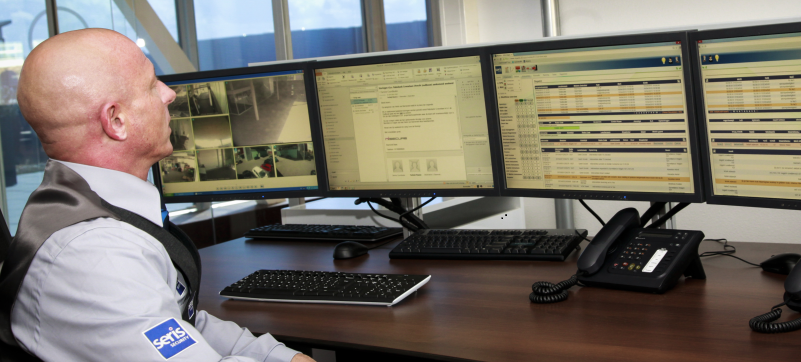
At ten to ten, your coworker drives off the premises. You watch the car until the taillights disappear around the bend, then turn toward a building where no one else is around. The keys are in your pocket, the walkie-talkie is on, and the first round starts in twenty minutes. From this moment on, you’re the one in charge.
Almost every security guard can remember that moment, even twenty years later. In Part 1 of this series, we described the process leading up to your first day on the job; in Part 2 we described how the training proceeds while you’re already working shifts. This third part is about the evening when the shadowing period ends.
How to Get Started with Your First Self-Employed Gig
With us, your first shift working independently as a security guard isn’t a fixed date on a training schedule. It’s preceded by a period during which you shadow colleagues who are familiar with the location—the so-called buddy system. After that, there comes a point when someone assesses whether you’ve mastered that location well enough to work there on your own.
That moment isn’t determined by a set number of shifts. At some locations, things become clear after three shadowing sessions; at others, there are enough exceptions that it takes much longer. What we’re assessing goes beyond the rounds and procedures. The question is whether you know which cleaning crew is still on the premises on Friday evenings, which alarm goes off automatically every Monday morning, and which door closes only when you lift it.
We believe that leaving a new colleague to fend for themselves too soon is an organizational mistake, not a learning opportunity. When someone encounters a situation for which no one has prepared them, they rarely learn anything useful from it. Above all, they remember that they were left to handle it on their own.
Staying Alert When Nothing Is Happening
The strange thing about that first shift is that usually nothing out of the ordinary happens. The first round goes exactly as it has ten times before. The doors are closed, the lights are on where they’re supposed to be, and the camera feeds show an empty lot.
And yet it feels different, because there’s no one walking beside you to tell you you’re doing it right. New colleagues often say afterward that they took twice as long on that first round, or that they walked back to a door they were sure was closed. You don’t need to be ashamed of that uncertainty. It’s the mindset you want to have in this job—just without the routine that sets the pace.
That attitude is precisely the skill that defines the essence of this profession, even though it’s never properly described in any job posting. The challenge isn’t dealing with the tense moments. The challenge is that on your 200th round, you’re still checking the same door with the same attention to detail as on your first, even though your brain has long since decided that nothing’s ever going to happen anyway.
Experienced security guards develop their own systems for this. One guard deliberately walks his route clockwise one time and counterclockwise the next, because that way you notice different things. Another makes it a rule to say one thing out loud during every check. Yet another changes his route as soon as he realizes he’s starting to go on autopilot.
At four in the morning, that gets harder. Your body is at the lowest point of its natural rhythm at that time, no matter how much coffee you drink. It’s also the time when you need to be most alert. That’s why, during the training, we focus on how to get through those hours.
The first decision you make on your own
Sooner or later—sometimes in your first week, and sometimes not until two months later—you’ll find yourself face-to-face with someone who isn’t supposed to be there. Or someone who is supposed to be there, but not at that particular time and without the prior notification required by the procedure.
The driver who shows up at the gate at a quarter past eleven at night with a delivery that, according to him, was scheduled for tomorrow morning. The employee who wants to enter with a colleague from another building, even though that colleague doesn’t have an access pass. The contractor who says he was here last week, too. What you learn in training gives you the legal framework. What you need in that moment is the site’s work instructions.
Things go wrong in two ways with new coworkers. The first is being too strict. You know the rules, you’ve just started here, and you’ve learned that procedure is procedure. Then you turn away an employee who’s been working here for twelve years because he forgot his ID card, even though a quick phone call to the right person would have resolved it in two minutes. What follows is a complaint, an awkward conversation, and a coworker who’s now turned against you for no good reason.
The second is being too accommodating. Someone pushes their point, gets irritated, or says that this is always how things go, and you let it slide because you’d rather avoid a confrontation. That works that night, but the next time you face the same situation, you’ll have an extra argument against you: last week, it was okay.
The middle ground lies in making a phone call. If you’re unsure, just call: a security guard who calls his supervisor at 11:30 to seek guidance is doing exactly what’s expected of him.
Je bent nooit echt alleen
For us, being on-site alone doesn’t mean you’re on your own. Our dispatch center takes your reports, your regional team leader, contract manager, or on-call staff are available, and in Dordrecht and Rotterdam, our patrol cars are constantly on the road, ensuring that someone can arrive on the scene relatively quickly if a situation escalates.
That is reassuring for candidates and one of the reasons clients choose us. A security guard who knows that help can arrive in a timely manner makes decisions with greater composure than someone who knows he has to handle the situation on his own.
Is security work dangerous?
Most shifts go off without a hitch. What you’ll encounter most often in practice is verbal aggression: people who get angry because they’re not allowed to do something, or because they feel you’re calling them out on something they didn’t do. Physical altercations do occur, but they’re rare. Dealing with them is covered in the training.
The main factors determining the risk are the type of location and the time of day. An office building in an industrial park is a completely different world from a location that’s open to the public. When scheduling, we consider the combination of location and individual: what works well for one person might be too early for another. So where you’re assigned during your initial period depends on what you can handle.
Our position on this is clear: you should only intervene physically when there is truly no other option, such as during a natural disaster. In virtually all other cases, the correct course of action is to retreat, report the incident, and wait for the police.
The end of your shift
At the end of your shift, you document what you’ve observed. For many new colleagues, this feels like paperwork that’s part of the job. In practice, it’s the only part of your shift that the client actually sees.
The facility manager who arrives at 8:00 a.m. reads your report from 5:15 p.m. What’s in that report determines whether he takes action that morning. A report that something happened at the side entrance doesn’t help him at all. A report stating that the side door was open at 3:14 a.m., that the lock appeared to be damaged, and that there were no signs of anyone having entered gives him enough information to call a repairman that same day. So write down what you observed and leave out your conclusions.
At six o’clock, your coworker arrives for the day shift. You fill them in on what’s happened and hand over the keys. Then you walk out. That handoff is shorter than it should be—across the entire industry. Knowledge is most easily lost in the few minutes it takes for one coworker to put on their coat and another to log in. We pay close attention to this, because some of what happens at a location isn’t recorded in any system and is passed on exclusively from person to person.
On the drive home, most people have the same thought: it wasn’t as bad as they’d expected. Nothing happened. The rounds were made, and the report is complete. You don’t notice what has actually changed until a few shifts later, when you walk past a door and, without even thinking about it, realize that something is different from yesterday.
In the fourth and final part of this blog series, we’ll look at what comes next: colleagues who, after about three years, want to pursue a different path, and the opportunities available within SERIS. Does this type of work sound like a good fit for you? Click the button below to view our job openings, which list the location type and shifts associated with each position.